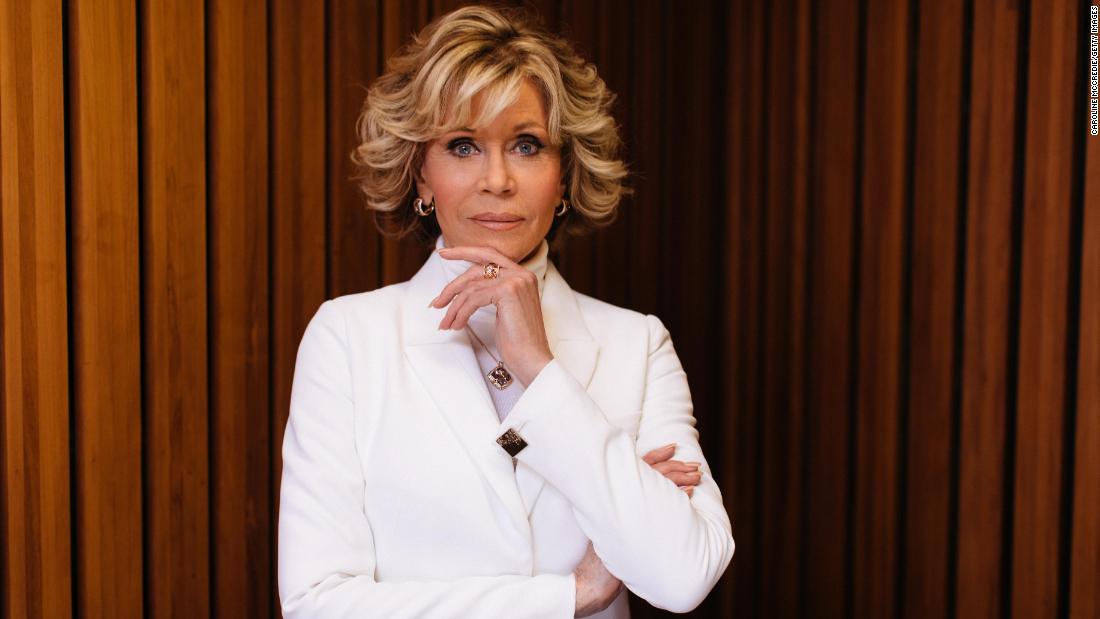
(CNN)Jane Fonda has been diagnosed with non-Hodgkin's Lymphoma and has begun chemotherapy treatment, the legendary actress and activist said in post shared on her verified social media account.
https://ift.tt/GoJinIS
Entertainment

(CNN)Jane Fonda has been diagnosed with non-Hodgkin's Lymphoma and has begun chemotherapy treatment, the legendary actress and activist said in post shared on her verified social media account.

Timothee Chalamet had all of Venice seeing red on Friday night at the world premiere of “Bones and All.” The actor donned a sparkling backless jumpsuit in a blood-red shade — a cheeky wink to the drama’s central protagonists, two cannibals in love.
The film, which reunites Chalamet with his “Call Me By Your Name” director Luca Guadagnino, lives up to its title with gory attacks and scenes that involve limb-chewing and eating. But despite the uncomfortable subject matter, the audience at the Venice premiere for the movie devoured “Bones and All.” The film received a 8.5-minute standing ovation, the longest and most enthusiastic of the festival so far. (It handily beat the previous record holder “Tar,” a drama starring Cate Blanchett as a tortured composer, which had a 6-minute ovation.)
As the crowds inside the Sala Grande cheered “Luca! Luca!,” the Italian director wiped tears from his eyes. Chalamet and the cast — including Taylor Russell, who plays the film’s anti-heroine Maren — walked down the steps of the theater’s mezzanine to welcome the crowd in the orchestra showering them with so much applause. And Chalamet encouraged the clapping to continue as he held up pieces of paper with Guadagnino and Russell’s names on them, meant to reserve their seats, to cue more applause.
Chalamet plays Lee, a pale young man who embarks on a road trip with a woman he meets who shares an equally troubled past. The odyssey is marked with self-exploration and murder (with a tone that suggests what you’d get if Guadagnino had been tapped to direct one of the “Twilight” films). In one scene set at a carnival, Lee seduces a man, suggesting that he’s bisexual (or maybe pansexual), but he eventually falls in love with Maren.
“Bones and All” is based on the novel of the same name by Camille DeAngelis. Guadagnino’s “Suspiria” writer David Kajganich adapted the script. The supporting cast includes Mark Rylance, Michael Stuhlbarg, André Holland, Jessica Harper, Chloë Sevigny, Francesca Scorsese and David Gordon Green.
Notably, “Bones and All” is Guadagnino’s first movie shot in the United States. It also marks a reunion between the director and Chalamet, who became one of the youngest best actor Oscar nominees in history thanks to his work on their first collaboration “Call Me By Your Name.” Guadagnino has called Chalamet’s role in “Bones and All” a heartbreaker.
“The second I read it, I said, I think only Timothee can play this role,” Guadagnino said in an interview last year. “He’s fantastic, a great performer and to see him soaring the way he is doing now, I feel proud of him. And this character is something very new for him, both endearing and heartbreaking.”
Guadagnino has had a rich history with the Venice Film Festival. His directorial debut “The Protagonists” debuted at the 1999 festival. His films “I Am Love,” “A Bigger Splash” and “Suspiria” also world premiered at Venice.
MGM is releasing “Bones and All” in theaters on Nov. 23.
Article From & Read More ( Timothée Chalamet’s Sexy Bisexual Cannibal Stuns Venice: ‘Bones and All’ Gets 8.5-Minute Standing Ovation - Variety )
Alejandro González Iñárritu’s first film set and shot in his native Mexico since he turned heads more than two decades ago with Amores Perros is as long and windy as its title. “It’s pretentious and pointlessly oneiric,” scoffs a fellow Mexican who has found success in crass commercialism rather than art and truth, dismissing the semi-autobiographical protagonist’s work. Iñárritu seems to be cheekily preempting his critics. However accurate you find that assessment, the epic existential comedy, Bardo, False Chronicle of a Handful of Truths, is also a work of exacting craftsmanship, shifting with beguiling fluidity between dream and reality with ravishing visuals, shot on 65mm by the great cinematographer Darius Khondji.
At three overstuffed hours, the Netflix feature is a lot of movie. While there’s pleasure in surrendering to its languid rhythms and sinuous narrative detours — I was never bored — it doesn’t escape charges of self-indulgence or derivativeness, borrowing from All That Jazz and The Great Beauty, as well as a key influence on both those films, Fellini’s Otto e Mezzo.
The Bottom Line A homecoming odyssey in a tragicomic key.
You might wish Iñárritu had tightened his focus, as his friend and colleague Alfonso Cuarón did with his childhood recollection, Roma. But this is deeply personal, immersive cinema that evinces much soul-searching, about both individual and national cultural identity, creeping mortality, the price of acclaim, the conflicted heart of the returning expatriate, the porousness of time and the seductive labyrinth of memory. Perhaps most revealing is the corrosive consideration of living and working in a country that has shown such cold imperialistic arrogance toward his own.
Co-written with Nicolás Giacobone, Iñárritu’s collaborator on Biutiful and Birdman, the script reimagines the director as Silverio (Daniel Giménez Cacho), a famed Mexican journalist and documentary maker living in Los Angeles for the past 20 years and due to receive a prestigious international award in Mexico City. He will be the first of his countrymen presented with that honor.
It opens with the shadow of an unseen man running across a vast expanse of scrubby desert, lifting off into flight, perhaps a nod to Birdman. That image returns at the end, this time clearly visible as Silverio, wandering alone in a land that will always have meaning for him.
The absurdist key is established in the scene that follows, in which Khondji’s camera floats down a hospital corridor to find Silverio awaiting the birth of his son. But doctors inform the child’s mother, Lucia (Griselda Siciliani), that he doesn’t want to come out into this broken world, proceeding to stuff the baby back inside her. That infant reappears at inopportune moments, notably during oral sex. It gradually emerges that he died just one day after being born, a tragedy that still pains Silverio and Lucia, as well as their grown children, teenage Lorenzo (Íker Sánchez Solano) and 20something Camila (Ximena Lamadrid).
While news reports inform of a U.S. government-approved plan by Amazon to purchase the state of Baja, Silverio prepares for the award ceremony and its related publicity. Or rather, he mostly avoids it as mixed feelings about being back in his home country overwhelm him.
At Mexico City’s Chapultapec Castle, the U.S. ambassador (Jay O. Sanders) glosses over Silverio’s pointed comments about the stacked odds of the Mexican-American War in the mid-1800s, prompting the documentarian to conjure a full-scale recreation of the battle that took place there, with uniformed cadets in bad period wigs. The use of a brass band in this surreal vignette is one of many elements that recall Fellini. (Elsewhere, the score by Bryce Dessner of The National and Iñárritu tends to function as atmospheric enhancement to the visuals.)
Mexican history comes alive in an equally unconventional though more somber way later on, as Silverio wanders the capital’s streets — initially empty, then bustling and cosmopolitan — and turns a corner to find desaparecidos dropping to the pavement all around him. Eventually, he comes upon a mountain of the tangled, naked corpses of Indigenous Mexicans, which he scrambles up, encountering Hernán Cortés, the Spanish conquistador responsible for the fall of the Aztec Empire, at the top.
These reflections on the brutalized history of Mexico, along with its spirituality and culture, are freely interwoven with evidence of the population’s ongoing struggles. Recurring scenes show mass migration north across the border, with Silverio in journalistic mode interviewing his fellow countrymen fleeing poverty, crime or violence, an affecting exodus seeking hope on “the other side.”
These snippets form a sprawling mosaic, but the film is most engaging when it builds extended set-pieces that fold gracefully from one development into the next. The most intoxicating of them is the festive award reception, at which old friends, family and professional colleagues gather for mescal and dancing as Khondji’s camera snakes its dexterous way through the crowd.
On the terrace, Silverio gets into a disagreement with his old friend, the aforementioned trash TV purveyor, disgruntled because the illustrious guest bailed without warning on a scheduled live appearance on his show. He accuses Silverio of failing to keep his ego out of his self-glorifying work, while Silverio responds by calling him a mediocre flag-waving nationalist — vulgar, stupid and proud of it.
The honoree then skips sharing the stage with a government dignitary and slips away into the men’s room, where he meets the dead father who was never able to express his pride in his son while he was alive. This refreshes the old man’s advice to him: “Take a swig of success, swish it around and spit it out, otherwise it will poison you.” He continues through another doorway, down another darkened corridor to his childhood bedroom, where masturbatory teen fantasies about a TV variety star return, followed by a visit with his elderly mother.
There’s a hypnotic quality to this freewheeling central section, a sustained charge that falters in some of the more prolix passages around it. Some of Silverio’s self-interrogation — about his fear of dying and leaving behind a legacy of meaningless work — feels familiar from too many artistic memoirs.
But there’s a soulful aspect to Silverio’s consideration of what it cost him and his family to leave their country behind. Calling him a “first-class immigrant,” Lorenzo prods at his father’s pangs of guilt about his privilege, evident when the family housekeeper is denied access to accompany them to the beach at a ritzy private resort. The bitter irony of Silverio’s relatively cushy existence is hammered home in a literal but effective scene at Los Angeles airport, where a Latino border agent informs him that his resident status doesn’t afford him the right to call America home.
The final section gazes forward in time to an outcome that finds Iñárritu — or Silverio — facing the inevitable, overcome with wonder, confusion and regret. “Success has been my biggest failure,” he confesses in one telling moment that fits with the ambivalent nature of a film whose skepticism toward what constitutes truth is inherent in its subtitle.
Audiences’ staying power for this meandering existential exploration of personal, professional and national identity — as tragicomic as it is rueful — will vary, depending on their interest in the artist or their appetite for the film’s aesthetic beauty. Even at the end of three hours, Silverio remains a somewhat elusive figure, though Giménez Cacho (seen recently in Zama and Memoria), with his lanky frame and saddened eyes, proves an eternally curious guide, responding in kind to the warmth and spontaneity of the family scenes.
Article From & Read More ( ‘Bardo, False Chronicle of a Handful of Truths’ Review: Alejandro G. Iñárritu’s Meandering Return to Mexico - Hollywood Reporter )
Keep up with the latest daily buzz with the BuzzFeed Daily newsletter!

The “year of change” at Saturday Night Live continues.
Deadline understands that Alex Moffat, Melissa Villaseñor and Aristotle Athari are not returning for Season 48 of the venerable NBC sketch show.
Moffat and Villaseñor both joined as featured players in 2016, while Athari joined last season. Moffat and Villaseñor were promoted to the main cast in 2018.
Villaseñor was the show’s second Latina cast member after Noel Wells and the first to be promoted to repertory status.
The departures come after Deadline revealed in May that Kate McKinnon, Aidy Bryant and Kyle Mooney were exiting in addition to Pete Davidson.
It comes after creator Lorne Michaels admitted that he was expecting this year to be a “year of change” for the show.
‘Saturday Night Live’: Actors Who’ve Hosted ‘SNL’ The Most – Photo Gallery
It’s not a huge surprise given that this past season – the show’s 47th – featured its largest-ever cast with 21 stars and eight cast members who were entering their eighth season or beyond.
It also follows the departure of Lindsay Shookus, a producer and head of its talent department, who is leaving after 20 years.
Article From & Read More ( ‘Saturday Night Live’: Alex Moffat, Melissa Villaseñor & Aristotle Athari Not Returning For Season 48 - Deadline )
Brendan Fraser. Photo: A24
In excellent news for people who like to yell about movies on Twitter (guilty), Darren Aronofsky has emerged wet and dripping from Mother! lake to direct his first film since 2017. Called The Whale, the drama is an adaptation of a Samuel D. Hunter Off Broadway play of the same name about a homebound, 600-pound English teacher named Charlie living with obesity and crippling grief who tries to reconcile with his estranged daughter before he almost inevitably dies too young. Aronofsky will stay true to the stifling setting of the play by setting the whole film in Charlie’s home. The action revolves entirely around this character, his perspective, and his pain.
Of course, this is a dream role for any serious actor who wants to give a big, deep, important performance. And of course of course, as is almost always the case, the role will be played by an actor, Brendan Fraser, in a fat suit and prosthetics. Fraser is less svelte than many Hollywood leading men, but he is also not 600 pounds, and a first-look article in Vanity Fair depicts his intensive process for transforming into Charlie. The article takes pains to call the prosthetics “empathetic” and “naturalistic,” and Fraser says it is nothing like “other body suits that had been used in comedies over the years, usually for a one-note joke,” and that he “learned quickly that it takes an incredibly strong person inside that body to be that person.”
The messaging in this first look is at odds with itself. On the one hand, Aronofsky and Fraser are taking great pains to emphasize their empathizing, stressing that Fraser consulted with the Obesity Action Coalition and aims to not fall into the traps of other pop-cultural depictions of people living with obesity. On the other hand, the article is full of technical details making a spectacle of the sheer weight and scale of the physical transformation with Fraser describing how the “torso piece was almost like a straight jacket” and that he had vertigo after taking it off:
Fraser carried anywhere from 50 to 300 extra pounds during filming, per Aronofsky, depending on the scene’s contents; further, Charlie is severely limited in mobility. (Several people were always on hand to assist Fraser in standing up, sitting down, wheeling him across the 70 or so steps between the studio and the makeup room.) At the start of production, Fraser would spend five to six hours in a makeup chair, each day, to become Charlie; by the end, they got that hour count down to two to three.
It’s clear that Aronofsky, Fraser, and the A24 publicity team are taking pains to show how The Whale will not reduce this character to the spectacle of his size, and yet it’s still being framed as an object of fascination that will surely fuel conversations surrounding Fraser’s performance once the film finally premieres at TIFF on September 11, where he’ll be given the Tribute Award for Performance. Furthermore, the character is queer and mourning the loss of his male soulmate, a Mormon named Alan. That’s a whole other representational quagmire. Still, we have faith in Fraser, who is due for another serious, celebrated star turn, but did it have to come via Christian Bale–ification? Pumpkin-spice season may already be here, but awards season isn’t quite yet. Brace yourself for the discourse while you can.
Article From & Read More ( Brendan Fraser On Playing Obese Character in 'The Whale' - Vulture )News of Meghan Markle's recent interview with The Cut all but broke the internet on Monday, so it's not all that surprising the British royal family has ~opinions~ about it...just not ones they'll admit directly in public. TL;DR: Insiders say they are definitely not pleased. In the wake of the interview, a source told Entertainment Tonight the “royal family is disappointed by Meghan Markle’s latest comments in The Cut magazine and on her podcast. They are distressed that after stepping back from the royal family—claiming a need for privacy—she continues to publicize family matters in public.” Okay, noted!
The source added there is a “loss of trust” with Meghan, which is the latest update in the alleged strain between Harry and Meghan and other members of the royal family.
This content is imported from Instagram. You may be able to find the same content in another format, or you may be able to find more information, at their web site.
During her talk with the publication, the Duchess of Sussex opened up about her life in Montecito, California and addressed the “bittersweet” transition she and her husband went through after making the decision to step away from formal royal duties in 2020. Prior to that, we now know that Meghan was required to give up control of her Instagram account, her lifestyle blog, and even her passport in order to officially join the royal family, though she says she “never had to sign anything that restricts me from talking,” therefore putting her in control of what she decides to publicize (or not!) about her own experiences. When discussing her feelings about the formal exit from the Firm, the duchess admitted it “takes a lot of effort to forgive.” *cue dramatic music here*
In the interview, Meghan also divulged intel about her privacy case against The Mail on Sunday, saying, “Harry said to me, 'I lost my dad in this process.' It doesn't have to be the same for them as it was for me, but that's his decision.” (However, following the discussion, it was clarified Entertainment Tonight that these remarks referred to her own father Thomas Markle—whom she's currently estranged from—not Harry's father, Prince Charles.)
Karwai TangGetty Images
Unfortunately, not even this explanation could stop another source close to Prince Charles from sharing with Entertainment Tonight that the future king was “saddened” over comments made in The Cut if Harry indeed felt his relationship with his father was so broken. The source also added, “The Prince of Wales loves both his sons.”
A refresher: The Cut interview was, in part, a promotion effort for the duchess' new Spotify podcast, Archetypes, which launched last week via a candid conversation between Meghan and Serena Williams. The series promises to “investigate, dissect and subvert the labels that try to hold women back,” per the podcast's show notes—and it seems that Meghan is sticking to its ethos. In its latest episode, the Duchess of Sussex sits down with singer Mariah Carey and discusses how her perception of race shifted once she began dating her husband in 2016.
This content is imported from Instagram. You may be able to find the same content in another format, or you may be able to find more information, at their web site.
“If there’s any time in my life that it’s been more focused on my race, it’s only when I started dating my husband,” she told Mariah. “Then I started to understand what it was like to be treated like a Black woman. Because up until then, I had been treated like a mixed woman. And things really shifted.”
Director-actor Michael B. Jordan ’s Creed III is a box office champ. If early estimates hold, the movie is on course to open to a better...